

A useful buffet table setup starts with the menu and the serving dishes, not a fixed number of tables per guest. Put plates at the start, arrange the food in a clear sequence, and leave utensils and napkins until the end. Give drinks their own station when space allows. Then test the whole arrangement with empty dishes before confirming your rental order.
For a New Jersey birthday, company lunch or family celebration, the challenge is often fitting food service around the rest of the event. Here is how to compare layouts, measure your tabletop needs and calculate the table-only part of the budget.
Choose a layout before counting tables
One-sided serving line
A straight line near a wall can work when the center of the room is needed for dining. Guests move along one side. Leave a way for the catering team to replenish dishes without squeezing through the queue, and check that the end of the line does not empty into a doorway. A wall position is not automatically suitable if staff need access behind the equipment.
Two-sided island
A freestanding island allows access from both sides, but only if the menu, utensils and serving vessels are arranged for it. Do not assume that two lines will work when everyone still reaches for the same spoon. Ask the caterer whether duplicated dishes or separate serving utensils are needed. Include the occupied space on both sides in the room plan.
Separate stations
Food, drinks and dessert can each have a designated surface. This makes the purpose of each table clearer, although it uses more floor space. A dessert table can also open later instead of being part of the main meal queue. Choose the layout that fits your room and staffing, rather than the one that looks fullest in a photograph.
Measure the dishes, not just the guest count
Party Perfect America’s 6-foot banquet table is listed at approximately 72 inches long, 30 inches wide and 29 inches tall. That gives you a defined surface to plan around, but it does not establish how many trays, drinks dispensers or people it can serve.
- List every serving bowl, platter, stand and piece of catering equipment that must be out at the same time.
- Measure the complete footprint, including handles, lids and room to use each serving utensil.
- Reserve separate space for plates, labels and the end-of-line napkins and cutlery.
- Draw each item to scale on a 72-by-30-inch rectangle. Check reach from the intended serving side.
- Repeat the arrangement with empty dishes and ask the caterer to approve it before ordering.
For example, if your measured arrangement needs 100 inches of length after allowing for handling space, it cannot fit along one 72-inch table. Two tables provide 144 inches in total when placed end-to-end. That is a length calculation, not proof that every item fits: width, seams, access, equipment instructions and the table’s suitability still need checking. Keep equipment supported on an appropriate surface rather than treating a join as one continuous platform.
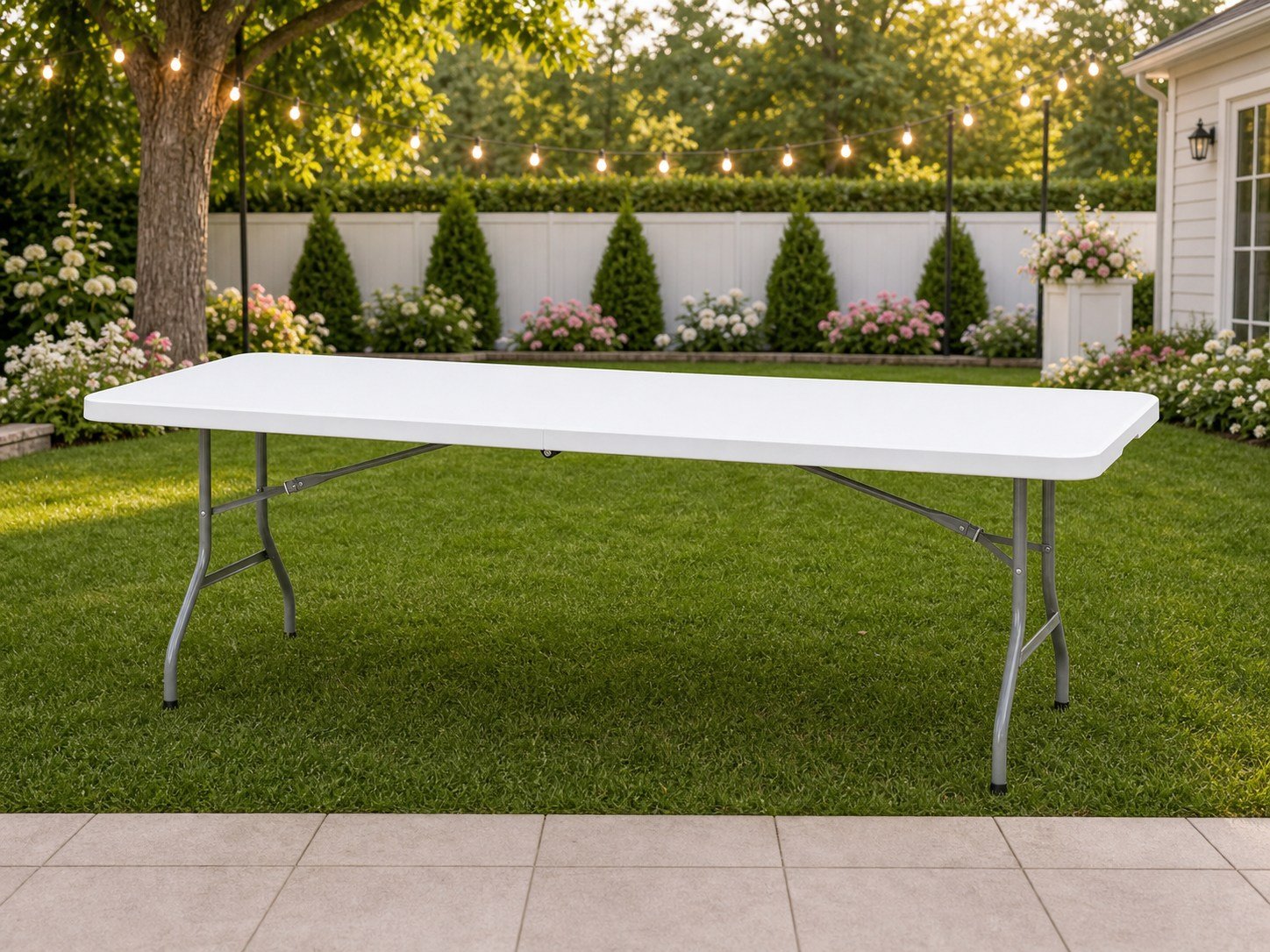
A sample buffet plan for a 50-person party
Use this as an example to adapt, not a rule that 50 guests require four tables. A compact menu served in repeated refills may need less display space than a smaller party with many dishes.
| Station | Example allocation | Check before booking |
|---|---|---|
| Main meal | Two 6-foot tables | Measured serving dishes and caterer access |
| Drinks | One 6-foot table | Dispenser footprint, cups and refills |
| Dessert | One optional table | Separate display or a later reset |
This example uses three tables if dessert is served after the main station is cleared, or four if it needs its own display. Confirm who clears and resets the surface; do not rely on a same-table plan when nobody is available to carry it out. Count dining tables separately using our 6-foot table seating guide.
Arrange the line around what guests carry
Plates at the start and utensils at the end mean fewer loose items to hold while serving. Caterer B&A Warehouse’s buffet planning guide also recommends a separate beverage table and laying out empty serving pieces in advance. These are useful starting points, not a substitute for the caterer’s plan for your menu.
Have the venue review the queue, routes to seating and access needs. Ask the caterer to manage food labels, dietary requirements, hot or cold holding and suitable equipment. Table rental alone does not supply those services or establish food-safety arrangements.
What will the tables cost?
As checked on October 7, 2026, PPA’s individual 6-foot banquet table listing is $10. Three tables therefore total $30; four total $40 in table rental items alone. These are not delivered-event quotes.
Confirm availability, rental period, taxes, delivery, setup and collection in writing. Linens, serving pieces, heating equipment and catering are not included in this calculation. For fabric sizing, use our 6-foot tablecloth guide and confirm who supplies and fits the covers.
Before you reserve
- Finalize the menu and number of dishes displayed simultaneously.
- Confirm the layout with the venue and caterer.
- Record food, drink, dessert and dining tables as separate quantities.
- Agree on delivery access, setup timing and collection arrangements.
Send Party Perfect America your event date, address and proposed table quantities to request availability and a complete quote. Include the room dimensions and catering requirements so the order reflects the actual event, not just the head count.