
There is no single national cleaning law written specifically for rented soft play at a birthday party. What exists is public-health guidance (CDC, state health departments, Head Start) and a manufacturer-focused equipment standard (ASTM F1918). Together they point to the same routine: clean first with soap and water, sanitize only what children mouth, disinfect only after illness or contamination, and let everything dry. Party Perfect America is based in North Brunswick, NJ, and the same logic guides how you should plan and care for any soft play rental at your event. Details for each rental, including setup and care, need to be confirmed for your booking.
TL;DR
- Cleaning means removing soil with soap and water. Per the CDC, cleaning alone removes most harmful germs from surfaces, and disinfecting is for areas where someone has obviously been ill.
- Play surfaces in indoor play areas should be cleaned and sanitized daily or more often, even when they look clean.
- Any product you use must follow its label: contact time, dilution, ventilation and never mixing chemicals.
- Soft and porous items are usually washed or vacuumed and fully dried, not sprayed with disinfectant.
- Ask your rental company about care instructions and event-day arrangements, then request a location-specific quote for your date.
Table of Contents
- Is there an official standard for soft play cleaning?
- Clean, sanitize, disinfect: three different jobs
- What a thorough routine looks like
- Using products safely
- Soft and porous materials
- When someone gets sick
- What to ask before you book soft play
- Staff routines that make a difference
- Planning soft play for your event in New Jersey
- FAQ
- Sources
Is there an official standard for soft play cleaning?
Not one that covers everything. Three layers apply, and it helps to know which is which.
Public-health guidance. The CDC’s facility cleaning guidance, dated April 2024, says to clean high-touch surfaces regularly and other surfaces when visibly dirty, and to disinfect areas where people have obviously been ill. It is guidance, not a permit requirement for a backyard party.
State and program schedules. The Minnesota Department of Health’s indoor play area guidance tells operators to clean and sanitize play surfaces daily or more often, even if they do not look dirty. Head Start’s cleaning schedule lists play activity centers for daily cleaning at the end of the day. Neither is a New Jersey rule, but both show what a sensible routine looks like.
Equipment standard. ASTM F1918-21, the standard for soft contained play equipment, asks manufacturers to specify non-flammable, non-toxic cleaning and sanitizing solutions compatible with their materials, and asks owners and operators to train staff on cleaning procedures. In practice, the manufacturer’s written care instructions are the starting point for choosing any product.
Clean, sanitize, disinfect: three different jobs
These words get used interchangeably, and they should not be.
- Cleaning removes dirt and germs with soap or detergent and water. Head Start’s product guidance prefers microfiber cloths.
- Sanitizing lowers germs on items children may put in their mouths. The CDC’s early care guidance says to use a diluted bleach solution or an EPA-registered sanitizing spray.
- Disinfecting is for when someone has been sick. It uses an EPA-registered product, or diluted bleach, kept visibly wet for the full contact time on the label.
The order matters: dirt blocks sanitizers and disinfectants, so soil comes off first.
What a thorough routine looks like
Use this as a general framework. It is not equipment-specific instruction, so always defer to the care instructions for the actual product.
- Clear the area. ASTM F1918-21 expects owners and operators to keep protective surfacing in and around use zones free of debris, clothing, footwear and other materials that could cause injury or infection. Shoes off and food out of the play zone make this much easier.
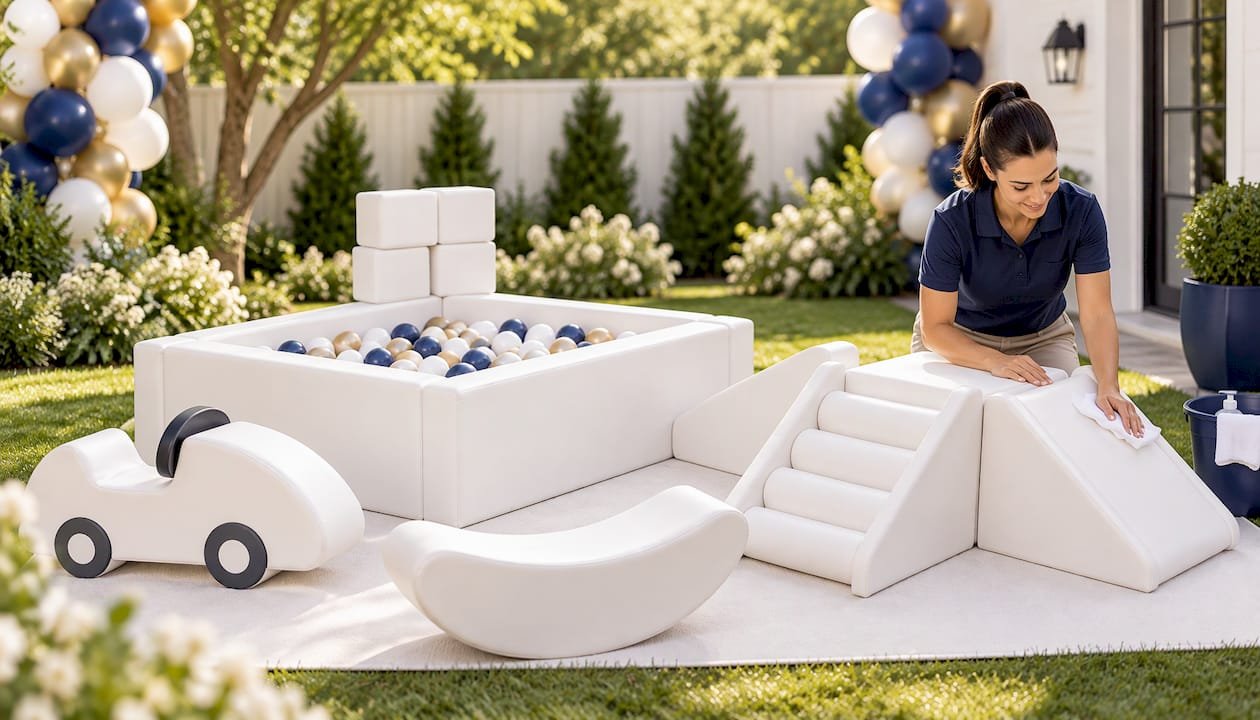
- Remove visible soil. Wipe vinyl surfaces with mild soap and warm water on a clean cloth. Vacuum or brush loose debris from seams and edges.
- Sanitize what gets mouthed. Toddler toys, ball-pit balls and soft blocks are the likely candidates. Use a product labeled for it.
- Rinse if the label says so, then dry fully. Moisture left behind is a separate problem from germs, and soft materials are best handled by thorough drying.
- Disinfect only when needed. After vomiting, diarrhea or another bodily-fluid incident, remove the soil, then disinfect with the label’s directions.
Using products safely
The label is the rule. Head Start’s guidance says to follow it for pre-cleaning, contact time, dilution, rinsing and protective equipment, to ventilate, and to store products out of children’s reach. Never mix or store bleach with other chemicals.
Contact time is how long a surface must stay visibly wet for the product to work, a definition the EPA’s List N page uses. Wiping a disinfectant off after a few seconds defeats the purpose. Labels differ: one EPA-registered disinfectant label lists play structures and soft surfaces among its use sites with a 4-minute contact time for listed bacteria, while a sanitizer label for fabric spot treatment calls for removing visible soil first, spraying 6 to 8 inches away until wet without saturating, leaving it wet 30 seconds and air drying. These are examples of how much labels vary, not instructions for any particular rental.
The CDC also notes that fogging, fumigation and wide-area or electrostatic spraying are not recommended as primary disinfection methods unless the product label permits them.
Businesses with employees using chemicals should also know that, under OSHA’s Hazard Communication Standard, Safety Data Sheets must be kept on site and staff trained on chemical use, as Head Start’s guidance explains.
Soft and porous materials
The Washington State Department of Health’s school cleaning guidance says soft or porous items are hard to disinfect and usually do not need it. Washing with soap and water, vacuuming and complete drying is the appropriate control, and it notes disinfectants can be harmful to children. For a party, that means a clean, dry play surface matters more than a strong chemical smell.

When someone gets sick
Handwashing is the most effective way to prevent germ spread in play areas, according to Minnesota’s health department. Hand sanitizer is no substitute for handwashing and is not effective against norovirus, a common cause of vomiting and diarrhea. Children with vomiting or diarrhea should not use the play area.
For hosts, that translates into simple event-day habits:
- Set a handwashing stop before the play area, and keep eating areas away from the equipment.
- Ask any child who is ill to sit out.
- If an accident happens, stop play, have the area cleaned and disinfected per the product label, and let it dry before play resumes.
What to ask before you book soft play
When you compare rentals, cleaning is one of several things to confirm. Ask:
- What care instructions apply to this specific equipment?
- What is the surface condition at delivery, and how is the equipment arranged on site?
- What does the rental duration cover, and what are the rules for shoes, food and drinks?
- What happens if an accident occurs during your event?
- What indoor or outdoor space is needed? Measure the room, doorways and floor.
Our Soft Play Zone 16×13 is one example of a layout to measure for. Our guide to planning an event with that zone walks through space planning, and the soft play age range guide helps you choose who it fits. For budgeting, see soft play rental cost. Inclusions, rental duration and pricing must be confirmed for each booking.
Staff routines that make a difference
Anyone managing a venue or organizing a community event can borrow from operator practice. Another type of business shows the same principle in a different setting: a routine kept consistent every day, with the right products for the material, as in this guide to daily cleaning routines and products. Write your own short checklist for the event: who wipes, when, with what, and who handles an accident.
Minnesota’s guidance also advises choosing sanitizers based on the play equipment manufacturer’s recommendations and using test kits to measure concentrations where applicable. That is a good habit for a venue that sanitizes regularly.
Planning soft play for your event in New Jersey
Party Perfect America is based in North Brunswick, NJ, and serves events in New Jersey, New York and Connecticut, subject to availability and delivery arrangements. Delivery depends on a location-specific quote, and availability is not guaranteed until confirmed. Our soft play and bounce rentals are on the Bounce & Play page, and our toddler party rentals in New Jersey page covers kids party bundles.
If you are weighing options for a young crowd, soft play vs bounce house compares both. For winter and holiday parties from November through February, indoor space is the main variable: check the room dimensions, entry doors and floor before you request a quote.
Send us your event date, location and requirements and we will provide a tailored quote. An inquiry is not a confirmed booking until the deposit and final payment are in place.
FAQ
How often should soft play equipment be cleaned?
Minnesota’s indoor play area guidance says play surfaces should be cleaned and sanitized daily or more often, even when they look clean. Head Start’s schedule lists play activity centers for daily cleaning at the end of the day. For a single-day event, that means a clean surface at the start and prompt cleanup of spills during play.
Do I need to disinfect soft play?
Usually, cleaning is enough. The CDC says cleaning alone removes most harmful germs, and disinfection is for areas where people have obviously been ill. Follow the product label for contact time if you do disinfect.
Can I use bleach on soft play?
Only as directed by the equipment’s care instructions and the product label. Never mix bleach with other chemicals, ventilate the space, and keep products away from children.
What should I do if a child gets sick at the party?
Stop play, keep the child away from the area and have a parent assist. Clean up the soil, then disinfect according to the label. Wash hands with soap and water, since sanitizer does not work against norovirus.
Sources
- CDC: When and How to Clean and Disinfect a Facility
- CDC: How To Clean and Disinfect Early Care and Education Settings
- Minnesota Department of Health: Indoor Play Area Maintenance and Sanitation
- HeadStart.gov: Schedule for Cleaning, Sanitizing, and Disinfecting
- HeadStart.gov: Selecting and Using Cleaning, Sanitizing, or Disinfecting Products
- EPA: List N Advanced Search Page
- EPA pesticide product label, CDQ, March 2022
- EPA pesticide product label, SALSA, October 2022
- Washington State Department of Health: Safe Cleaning and Disinfecting Guidance for Schools
- ASTM F1918-21: Soft Contained Play Equipment
- Daily cleaning routines and products