

Soft play is built mainly for babies, toddlers and young preschoolers. Most toddler-focused equipment targets roughly 6 months to 3 years, and some sets stretch to about 5 depending on the child’s mobility and confidence. The exact range depends on the equipment, so you need to confirm it for the specific set you rent. We are Party Perfect America, an event rental company based in North Brunswick, NJ. This guide explains how age ranges are defined, what a first birthday needs, and how to plan a party when guests are different ages.
TL;DR
- Soft play is designed for young children. Toddler-focused sets commonly target about 6 months to 3 years, and some extend toward 5 (Little People’s Cove).
- Age is only a starting point. Sitting, crawling, walking and confidence matter as much as the birthday count.
- For a first birthday, plan a separate, supervised area for the babies, with adults close by at all times.
- Keep older kids and toddlers in separate zones, or schedule them in separate time blocks.
- Always confirm the recommended age range, size and setup requirements for the exact set. Request a quote and we will go over it with you.
Table of Contents
- The short answer: soft play by age
- How safety standards define the age groups
- Why developmental stage matters more than the birthday
- Soft play for a first birthday
- Toddlers, ages 2 and 3
- Preschoolers, ages 3 to 5
- Mixed ages: keeping little ones safe
- Supervision: the part no age range replaces
- Questions to ask before you book
- Our soft play rentals in New Jersey
- A simple plan for a one-hour toddler party
- FAQ
- Sources
The short answer: soft play by age
No single number fits every product. Safety documents and manufacturers define young age groups in slightly different ways, and your guest list will have its own mix. This table pulls the commonly used ranges together so you can see where your child or guest list likely falls.
| Age group | Typical fit for soft play | What to plan for |
|---|---|---|
| Under 6 months | Not a typical user group for party equipment | Keep them with a caregiver in a calm area beside the play zone |
| 6 to 12 months | Possible for sitters and crawlers on low, soft elements | Close adult contact, no ball pit until they are developmentally ready |
| 12 to 23 months | The core toddler group | A toddler-only area, adults within arm’s reach |
| 2 to 3 years | Well suited to toddler soft play | Low climbs, gentle slides, space to run |
| 3 to 5 years | Fits some sets, depending on mobility and confidence | Check the set’s size and height guidance |
| 5 and older | Usually outgrow toddler sets | Consider a bounce house or a separate activity |
The ranges above come from the sources linked in the sections below. They are general guidance, not instructions for any specific rental unit. For the equipment you book, the age and size guidance on the product page and from our team is what counts.
How safety standards define the age groups
Two U.S. standards are useful reference points because they show how the industry thinks about young children.
- ASTM F2373 covers public use play equipment for children from the 5th percentile 6-month-old through the 95th percentile 23-month-old, indoors and outdoors (ASTM F2373).
- ASTM F1918, the specification for soft contained play equipment, covers users from the 5th percentile 2-year-old to the 95th percentile 12-year-old (ASTM F1918).
The U.S. Consumer Product Safety Commission’s playground handbook uses similar groupings. It defines toddlers as 6 through 23 months, preschool-age as 2 through 5 years, and school-age as 5 through 12 years. It also recommends separating play areas for different age groups at least by a buffer zone (CPSC Public Playground Safety Handbook).
The takeaway for party planning is practical. A child under 2 and a child of 9 are in different categories, and mixing them in the same space is the thing to design around. These standards describe categories of equipment, not our rental units, so treat them as context and confirm specifics for the set you choose.
Why developmental stage matters more than the birthday
Two 14-month-olds can be very different. One may be cruising along furniture, the other may be an enthusiastic runner. Head Start’s guidance notes that play structures for toddlers should suit their size and developing skills, with lower structures, wider and more moderate steps, and gradual inclines so toddlers can run, jump and climb safely (Head Start).
A quick way to size up your child before you book:
- Can they sit up without help? If not, they are likely better on a blanket beside the play area.
- Are they crawling or walking confidently? That is when low soft elements become fun rather than overwhelming.
- Do they put everything in their mouth? Loose pieces and small balls need extra care and attention.
- How do they handle bigger kids? A shy or unsteady toddler may need a quieter time slot.
The American Academy of Pediatrics also describes how play supports cognitive, physical, social and emotional development, with tips for families of children from birth to age 6 (AAP, The Power of Play). That is a good reminder that the goal of a soft play corner is easy, safe, self-directed movement, not pushing a child into activities that are too big for them.
Soft play for a first birthday
Many families ask us whether soft play works for a 1st birthday. It can, as long as you plan it around what one-year-olds can actually do. Some are barely walking, many guests will be even younger, and the grown-ups will be hovering the whole time. That is normal and worth planning for.
Babies under a year
For babies who are not yet mobile, soft play is more of a place to sit, look and reach than a place to climb. Seattle Children’s advises that toys for babies up to 12 months be non-toxic, safe for mouthing, free of small parts and sharp edges, and that balls be large enough that they cannot be swallowed when squashed (Seattle Children’s).
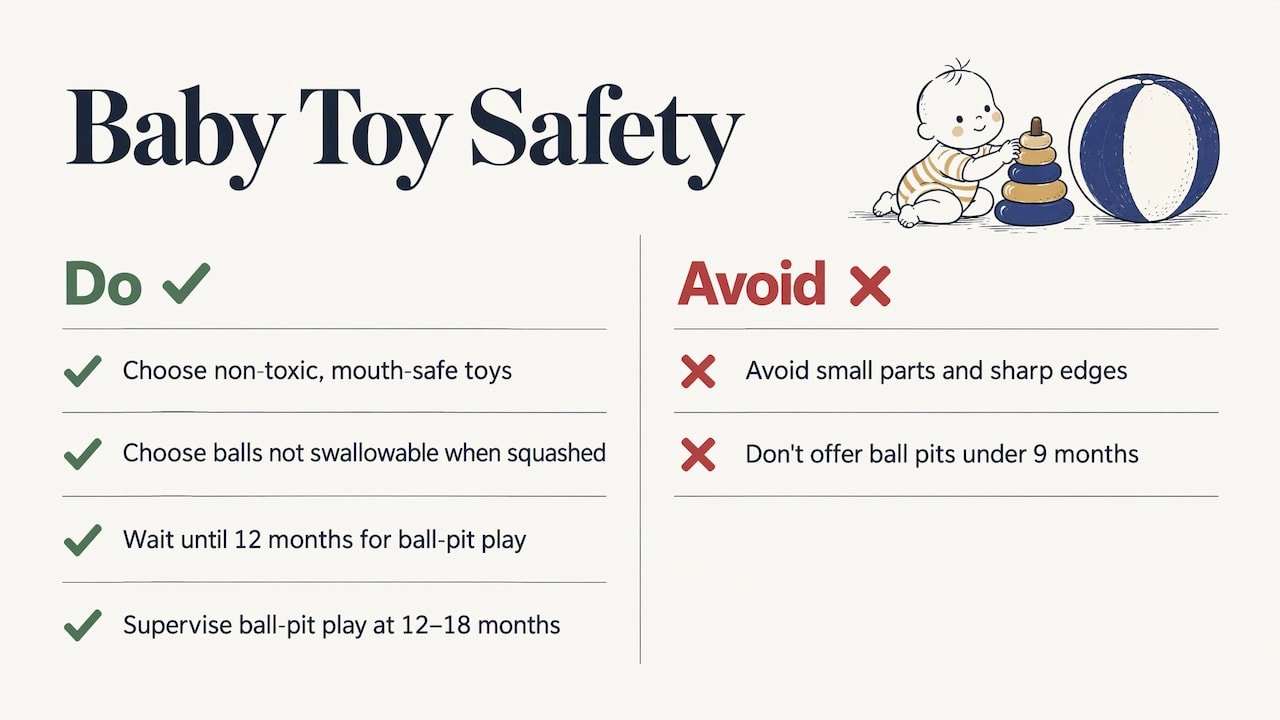
Ball pits deserve a specific mention. One 2026 parent’s guide says babies under 9 months are not recommended for ball pit play, and that most pediatric experts suggest waiting until at least 12 months, when children can sit independently. It describes 12 to 18 months as the window where most one-year-olds are ready for supervised ball pit play (Playroom Collective). If your baby is not sitting steadily, ask your pediatrician what is right for your child.
Setting up a first birthday zone
- Keep it small and low. One-year-olds do not need a big structure, just a defined soft area where they can crawl and pull up.
- Plan seating at the edge. Parents and grandparents will want to be close, so leave room for chairs and a diaper bag station.
- Dress for safety. The CPSC checklist for soft contained play advises removing clothing strings, necklaces, earrings and loose items from pockets before entry (CPSC checklist).
- Think about the cake and nap schedule. A first-birthday party usually works best in a short window, often built around the baby’s usual nap.
- Check what else you are adding. The American Academy of Pediatrics recommends reading age labels on toys and making sure all parts are larger than a child’s mouth (HealthyChildren.org). That applies to extras like toys and decorations you bring in.
For layout and timetable ideas built around a younger crowd, see our guide to soft play party ideas.
Toddlers, ages 2 and 3
This is the sweet spot. Two- and three-year-olds can walk, climb low steps, crawl through tunnels and slide gently, and they love repeating it. Head Start’s guidance reflects why: toddlers are curious, increasingly mobile, and do not yet judge distance or personal space well (Head Start).
For a party of toddlers, a compact soft play set with clear sight lines works well. Our Soft Play Zone 16×13 is named for its footprint of 16 by 13 feet. Confirm the current contents, recommended ages and setup space on the product page before you book. If you want to see how a zone fits into a full schedule, our soft play zone planning guide walks through it.

Preschoolers, ages 3 to 5
Some toddler sets work up to about age 5 depending on the child’s mobility and confidence, according to Little People’s Cove. In practice, a 4-year-old may enjoy it for a short while, then want something bigger. Older preschoolers are also more energetic, which can be a lot for a one-year-old sharing the same floor.
If your guest list is mostly 3 to 5, you have two good options:
- A soft play area for the youngest guests, plus a different activity such as a bounce house for the older ones.
- A staggered schedule, with toddlers first and older preschoolers second.
Our comparison of soft play vs a bounce house helps you decide which fits your guest list.
Mixed ages: keeping little ones safe
The most common challenge is not the birthday child. It is the cousins, siblings and neighbors of every size. The CPSC says that when children of different ages share a soft contained play area, the younger and smaller ones face more risk of collisions and rougher play, which makes age separation and supervision critical (CPSC Soft Contained Play Equipment Safety Review).
Three ways to handle it:
- Separate zones. Put the toddler soft play on one side of the space and the older-kid activity on the other, with a clear gap and an adult at each.
- Time blocks. For example, toddlers from the start of the party, then older children after cake. Choose times that match your own schedule.
- Rules posted at the entrance. Shoes off, no pocket items, toddlers only in the toddler area. The CPSC checklist also advises keeping smaller children in the toddler section and not letting children linger at slide exits or at the base of climbing equipment in a ball pool (CPSC checklist).
If you are planning a backyard party in New Jersey, our backyard bounce house and soft play planning guide covers layout and space. Also think about the venue itself. Whether you are hosting at home, in a hall or in a rented space, choosing a family celebration venue with room for a separate toddler corner makes supervision much easier.
Supervision: the part no age range replaces
Soft equipment is gentler than hard surfaces, but it does not run itself. The CPSC states that adult supervision is critical so children stay in age-appropriate areas and use equipment within their abilities, and that a properly supervised and maintained soft contained play environment is a safe alternative to traditional playgrounds (CPSC review).
Head Start suggests six active supervision strategies for toddlers: set up the environment, position yourself well, scan and count, listen, anticipate behavior, and engage and redirect (Head Start). At a party, here is how that looks:
- Name one adult per time slot who is the designated watcher, so everyone is not assuming someone else is looking.
- Count heads at the start, and again after cake.
- Stand where you can see every part of the play area, not behind a table.
- Step in early when a bigger child comes in too fast.
This is general guidance for parents and hosts. It is not a substitute for the setup, use and supervision instructions that come with a specific rental, which we will confirm with you when you book.
Questions to ask before you book
Use this list with any provider, including us:
- What age and size range is this specific set recommended for?
- What are the footprint and any height or clearance needs, in feet and inches, indoors or outdoors?
- What surface will it be on? A flat, clear area matters, and our team will confirm what a set needs.
- How many children at a time is it suited to?
- What is included, such as the mats, pieces, and delivery and setup?
- What are the delivery, setup and pickup arrangements for your address?
- How long is the rental period, and what is the cost for the full package?
Prices, inclusions, rental durations and availability are confirmed for each booking. Delivery is subject to availability and a quote based on your location. For a breakdown of what to compare on cost, read our soft play rental cost guide.
Our soft play rentals in New Jersey
We are based in North Brunswick, NJ and serve events in New Jersey, New York and Connecticut, subject to availability and delivery arrangements. Our soft play rental in NJ options are built for toddler parties, and you can pair them with a bounce house for a mixed-age guest list. The Little Stars Package is one bundle to review, and you can see everything on our bounce and play rentals page. Tell us your child’s age, your guest count, your event date and your address, and we will build a quote.

If you are hosting in Queens, see our Queens kids birthday party rentals page for what we offer there.
A simple plan for a one-hour toddler party
A sample, which you can change to suit your own child and venue:
- First 10 minutes: Guests arrive, shoes off, adults review the toddler-only rule.
- Next 25 minutes: Free play in the soft play area, with one adult watching.
- Next 15 minutes: Snack and cake at a table away from the play area.
- Last 10 minutes: Quiet play, photos and goodbyes.
Keep food away from the equipment, and think about which children are allergic to what. A small party of 6 to 10 toddlers is easier to supervise than a big one, but your own comfort level and space should set the number.
FAQ
What age is soft play for?
Soft play is made mainly for babies, toddlers and young preschoolers. Toddler sets commonly target about 6 months to 3 years, with some extending toward 5 (Little People’s Cove). Check the recommended range for the specific set you rent.
What age can a baby use soft play?
Standards for toddler play equipment begin at about 6 months (ASTM F2373). Readiness depends on whether the baby can sit and move safely, so ask your pediatrician if you are unsure. Adults should stay within arm’s reach.
Is soft play good for a 1st birthday?
It can be, if you plan for babies who are just starting to crawl or walk. Keep the area small and low, keep the youngest guests separate from older kids, and have adults close by. Our team can help you choose a setup for your date and location.
Is a 7-year-old too old for soft play?
Most toddler soft play is too small for a 7-year-old. School-age children fall in a different category, which the CPSC defines as 5 through 12 years (CPSC handbook). A bounce house or another activity usually suits them better.
Sources
- ASTM F2373 standard for public use play equipment
- ASTM F1918 standard for soft contained play equipment
- CPSC Public Playground Safety Handbook
- CPSC Soft Contained Play Equipment Safety Checklist
- CPSC Soft Contained Play Equipment Safety Review
- Head Start: Tips for Keeping Children Safe
- AAP: The Power of Play
- Seattle Children’s: Toys and Play, Birth to 12 Months
- HealthyChildren.org: How to Buy Safe Toys
- Little People’s Cove: Soft Play Equipment by Age
- Playroom Collective: Are Ball Pits Safe?