

Plan your delivery window by working backward from the moment guests arrive. Write down when the venue lets vendors in, how long each rental takes to set up, and when the last item must be ready. Then ask your rental company for a window that fits inside those limits, and get it confirmed in writing. Party Perfect America is based in North Brunswick, NJ, and delivery for events in New Jersey, New York and Connecticut is subject to availability and a location-specific quote, so the window is something you settle for your event, not something you assume.
This guide is for anyone with rentals arriving at an event: a birthday at home, a wedding at a hall, a corporate event, a community gathering, or a venue and planner coordinating several vendors.
TL;DR
- A delivery window is a span of time, not an arrival time. A truck can show up at any point inside it.
- The whole window must sit inside the hours the venue allows vendors in, and the pickup window inside the hours items may stay.
- Build the plan backward from guest arrival, and add a buffer of 15 to 30 minutes between major steps.
- Ask every supplier whether the quote includes setup or drop-off only, because the answer changes your timeline.
- Share one timeline with every vendor and give each one a single on-site contact with a working phone number.
Table of Contents
- What a delivery window actually means
- Start with the fixed times
- Match the window to venue access
- Work backward from guest arrival
- How much buffer to allow
- Ask the right questions when you request a window
- Build one shared timeline
- Match the plan to your type of event
- If the delivery is late or the window changes
- Request a delivery window for your event
- FAQ
- Sources
What a delivery window actually means
When a rental company says your items will arrive between 8:00 a.m. and 2:00 p.m., the truck may arrive at any point in those six hours, not at 8:00. That is how most delivery routes work: one vehicle serves several customers, and the order of stops depends on traffic, load size and distance.
So plan around the end of the window, not the start. If the window closes at 2:00 p.m. and the caterer needs tables in place by 2:00 p.m., you have no room for a late truck. Either ask for a narrower or earlier window, or ask the venue whether it can open earlier and at what cost.
The same logic applies to pickup. Pickup is also a window, and it needs the venue open and someone present, so note both the delivery and pickup dates and times.
Start with the fixed times
Before you ask for any window, collect the times nobody can move. A catering run-of-show guide suggests starting with fixed external times taken from actual venue documents: venue access start, loading dock or elevator reservation, rental delivery window, setup access, guest arrival, food service start, venue cutoff or curfew, rental pickup and final load-out.
For most events, that list looks like this:
- Venue access opens. The earliest a vendor may enter.
- Guest arrival. The deadline everything else works back from.
- Venue cutoff. When the room, tent site or yard must be clear.
- Pickup allowance. How long rentals may stay after the event.
If you are hosting at home, your fixed times are different but just as real: when the street is clear for a truck, when a neighbor’s driveway is available, when the grass is dry enough to cross, and when family members who will help are free.
Match the window to venue access
Check that the full delivery window falls inside the venue’s vendor access hours. A window that starts before the building opens is a window that can fail through nobody’s fault.
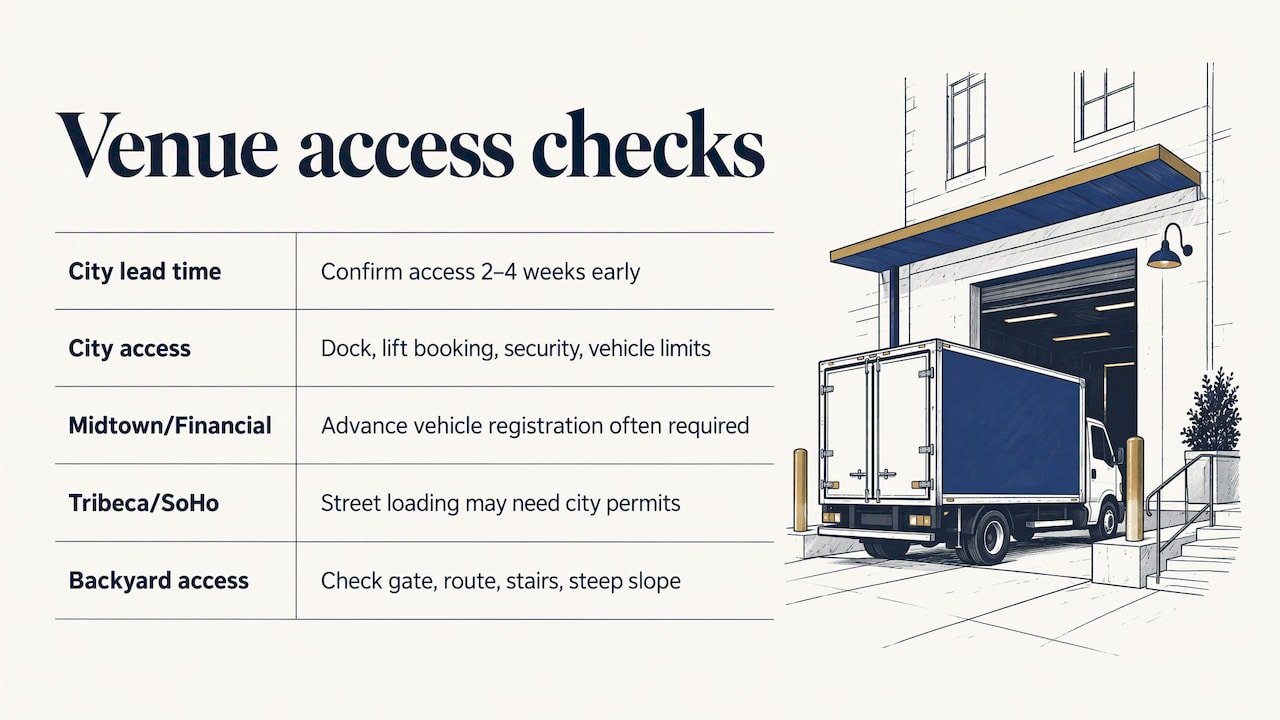
For venues in the city, confirm access details early. One New York delivery checklist advises confirming them two to four weeks before the event: loading dock location and hours, freight elevator reservations, security check-in procedures and vehicle size limits. It notes that many Midtown and Financial District buildings require advance vehicle registration, while some Tribeca and SoHo venues have no loading dock and need street-level loading with city permits. If your event is in Manhattan, Brooklyn or Jersey City, ask your venue contact about these before you pick a delivery time.
Some venues also ask vendors, and sometimes hosts, to carry liability coverage before anything is unloaded. If yours does, sort it out at the same time as access hours. This overview of general liability insurance for events explains the basics. Ask the venue exactly what it requires, because the rules differ from place to place.
For New Jersey backyard events, the access questions are simpler but still matter: Is there a gate, and how wide is it? Can a vehicle reach the setup spot, or will items be carried across the lawn? Is there a stairway or a steep slope? Our tent, table and chair planning guide for outdoor events covers site questions that affect where items can be placed.
Work backward from guest arrival
The most dependable method is a backward schedule. A vendor coordination guide recommends a master timeline that works backward from event start and includes venue access, delivery sequences by vendor, rehearsal or technical check times, buffer time for traffic, labor and weather, and a breakdown and pickup schedule.
Here is a worked example for a Saturday evening wedding reception with a 5:00 p.m. guest arrival, a hall that opens to vendors at 10:00 a.m., and a photo booth, tables and chairs, and a marquee letter display.
| Time | Step | Why it sits there |
|---|---|---|
| 10:00 a.m. | Venue opens to vendors | Fixed by the venue |
| 10:00 a.m. to 12:00 p.m. | Tables and chairs delivery window | Everything else depends on the room layout |
| 12:00 p.m. | Room layout check | Leaves time to fix anything before décor goes in |
| 12:00 to 2:00 p.m. | Décor and letters window | Goes in after the furniture is positioned |
| 2:00 to 3:30 p.m. | Photo booth window | Needs floor space, power and a clear wall |
| 3:30 to 4:30 p.m. | Buffer and final walk-through | Absorbs a late truck |
| 5:00 p.m. | Guests arrive | The deadline |
This is a sample layout to show the method, not a schedule for any specific product or a promise of any time. Your actual windows depend on your venue, your date and the quote you receive.
Why the order matters
Deliveries unlock each other. Furniture comes first because the caterer and decorator need it in place. Décor goes in before anything that blocks walkways. Equipment that needs power or floor space for guests, such as a photo booth, goes where the layout has left room for it. Writing down what each task needs before it can start keeps the schedule honest: if the answer is “the tables are placed,” the next window should not open before the first one closes.

How much buffer to allow
There is no universal number that makes a tight schedule safe. Still, a few benchmarks from planning guidance are useful:
- Add 15 to 30 minutes of buffer between major transitions so one delay does not cascade into the next.
- Build a 30-minute cushion ahead of your first delivery of the day. If load-in starts at 8 a.m., the first delivery should be scheduled for 7:30 a.m., according to a New York delivery checklist, and that assumes your venue allows access at that hour.
- Leave a longer cushion when the setup involves the weather: tents in November through March, outdoor seating after rain, or anything that needs the ground to be dry.
If the schedule looks too tight, the fix is the access agreement or the amount of work, not hoping crews move faster. Move the guest arrival, widen the setup time, or ask for an earlier window.
Winter and holiday timing in New Jersey
Between November and February, holiday parties, indoor birthdays and winter weddings often share the same weekends, and daylight is short. Plan for earlier sunset when anything is outdoors, allow extra time for cold-weather loading and icy walkways, and keep a backup indoor spot in mind for items you planned to place outside. If you are looking ahead to a spring or summer event, the useful move now is to ask about your date early, since availability is confirmed per booking.
Ask the right questions when you request a window
When you request delivery, be specific about the address, the setup spot, the access details and the time you need everything ready. Then ask these:
- What window do you expect for delivery, and what window for pickup?
- Does the quote include setup, or drop-off only? A common mistake is leaving “setup” undefined, and the answer changes the whole timeline.
- Can the window be narrowed? Narrower windows are not always available, so ask rather than assume.
- Who calls whom on the day? Get a phone number for arrival updates and give one in return.
- What access do you need? Parking, gate width, stairs, elevators, power and a flat surface.
- What happens if the venue is not ready when the truck arrives? Ask before the day, not at the curb.
At Party Perfect America, delivery, setup and pricing are confirmed for each booking, and a delivery fee is part of your location-specific quote. We can’t promise free delivery or guaranteed availability for any date, so the right order is to check your date first and then settle the window. An inquiry is a request, not a booking: your event is confirmed when the booking itself is confirmed.
Get the answer in writing. A confirmation email that states the delivery window, pickup window, address and on-site contact gives everybody the same reference if plans change.
Build one shared timeline
A schedule only the host can see does not help the driver. One planning guide recommends sharing a vendor timeline template with columns for vendor, arrival, load-in door, setup window, ready-by time, teardown out-by time and exit route. Arizona State University’s event planning guide suggests a setup and delivery itinerary in chronological order, from the earliest delivery to the final pickup. For each delivery, list the time, items, location, contact person and phone number, and special instructions. If several vendors deliver to the same location, list each one separately in order of arrival.
A simple version looks like this:
| Vendor | Items | Window | Door or spot | On-site contact | Ready by |
|---|---|---|---|---|---|
| Rental company | Tables and chairs | 10:00 a.m. to 12:00 p.m. | Side entrance | Name and phone | 12:00 p.m. |
| Decor | Letters and backdrop | 12:00 to 2:00 p.m. | Main hall | Name and phone | 2:00 p.m. |
| Photo booth | Booth and attendant | 2:00 to 3:30 p.m. | Rear wall | Name and phone | 3:30 p.m. |
Two habits keep this useful. First, review it before sending to confirm every time is accurate and in the order it will happen. Second, name one person on site who knows the layout, can open doors and can direct drivers, and give that number to every vendor. That person should not also be the host welcoming guests, the bride getting ready or the parent entertaining children.
Plan the pickup as carefully as the delivery
Pickup windows cause quiet problems. A truck that arrives before equipment is packed up can create waiting charges, so book collections with the same care as deliveries, as event logistics guidance points out. A real load-in and load-out schedule from a public event shows the pattern: tent and portable restrooms arrive the afternoon before, rentals arrive on event morning, and pickup is staged the next morning with the planner verifying the site afterward. Your event is likely smaller, but the idea carries over: decide who confirms the space is clear and by when.
For a birthday party at home, that may mean the last guest leaves at 4:00 p.m. and pickup is the next morning. For a venue event with a hard curfew, it may mean everything must be out the same night. Know which you have before you pick the date.
Match the plan to your type of event
Kids’ birthday parties
Bounce houses and soft play need a clear, level spot, so the window matters most for access and the surface, not the party itself. Aim for setup to finish well before the first guest arrives, and keep children away from the area while a delivery is under way. Browse our bounce and play rentals and tell us the yard or room size, in feet, when you ask about a date.
Weddings
Weddings stack the most vendors into the smallest space of time. Ceremony, cocktail hour and reception layouts often use the same room, so furniture, décor and any photo booth need a sequence. If you want a booth, the wedding photo booth rental page is the place to see the options. Confirm with the venue where the booth can go and where power is.
Corporate events and venues
Planners and venues should treat the delivery window as a contract term between three parties: the rental company, the venue and the event owner. Share the venue’s loading dock rules in the first email, and keep an entry on your timeline for every vendor so nothing blocks the dock.
Community gatherings
For parks, parking lots and church grounds, add the permission step: who approves vehicles on the grounds, and when does the site open? Confirm those before asking for a window.
If the delivery is late or the window changes
A late truck is manageable when you have planned for it. Keep the cushion before guest arrival, then work through these steps:
- Call the number you were given. Ask for a revised arrival time rather than waiting.
- Check the venue. Confirm the new time still falls within vendor access hours, and tell the venue contact.
- Reorder the day. If one vendor is late, let another start first when the space allows it. Your shared timeline shows what depends on what.
- Brief your on-site contact. One person decides, so the plan does not change in three places at once.
- Write down what changed. Note times and names for your records.
If you are the one changing the window, because the venue moved its access time or the guest count changed, tell the rental company as early as you can. Availability for a new time is not guaranteed, and the earlier the request, the more options there are.
Request a delivery window for your event
We are a New Jersey event rental company in North Brunswick, offering photo booths, bounce houses and soft play, tents, tables and chairs, décor and marquee letters, and proposal packages for events in New Jersey, New York and Connecticut. Because items from several categories can be coordinated through one request, you can build a tailored package and share your event location, date and requirements in one quote request. Our service areas page lists the towns and boroughs we’ve worked to cover, and our tents, tables and chairs offerings are a common starting point for hosts building a timeline around furniture.

Before you request a quote, have your event date, address, venue access hours, setup spot and a target ready-by time on hand. Check your event date and we’ll confirm availability, delivery, setup and pricing for your booking.
FAQ
How long is a typical event rental delivery window?
It varies by company, route and day. Some logistics services quote windows as tight as 30 to 90 minutes, while others use two to four hours, and rental windows for events can be wider. Ask what your specific window will be and get it confirmed in writing.
How early should deliveries arrive before an event?
Early enough that setup finishes, you walk the space, and a delay still leaves a cushion. Many planners add 15 to 30 minutes between major steps and a 30-minute cushion before the first delivery. Work backward from guest arrival and the venue’s access hours.
Do I need to be present for delivery and pickup?
Someone who knows the layout should be on site and reachable for both. That can be you, a venue contact or a trusted friend. Give the rental company that person’s phone number.
Does the delivery window include setup?
Not always. Ask whether your quote covers setup or drop-off only, and which items each applies to. Confirm this before you finalize the timeline.
Sources
- Equipment – Event Planning Guide, Arizona State University
- Load-in and load-out schedule example, Waterfront Development Corporation
- Event Delivery Planning Checklist for NYC
- Wedding rental delivery and pickup: how windows work
- How to Coordinate Planner and Vendors for a Smooth Event
- How Do You Coordinate Multiple Event Vendors?
- Event Logistics: Planning Checklist, Timeline and Example
- Catering Event Timeline: Run of Show Checklist
- Safeguarding Your Event with General Liability Insurance