

A good corporate event checklist runs in five stages: set the goal and budget, lock the venue and vendors, confirm the details in the final week, run the day from a written plan, then close out with feedback and a budget review. Below is that checklist in the order you will actually work through it, with notes for planners in New Jersey, New York and Connecticut. It also covers the rental pieces (seating, tents, photo booths, branded decor) that are easy to leave until too late.
We are Party Perfect America, an event rental business based in North Brunswick, NJ. This guide is general planning advice for company events, from team parties to client appreciation evenings. It is not a set of instructions for any specific piece of equipment, and every rental detail should be confirmed with your provider.
TL;DR
- Start with one written goal and a way to measure it, then build the budget around it, keeping part of it uncommitted for surprises.
- Book venue, catering and rentals early, and ask each vendor what is included before you compare prices.
- In the final week, lock your guest count, your run of show and every vendor’s arrival time.
- Plan access, exits and an emergency plan before the event, not on the day.
- Close out with thank-yous, a survey, an invoice review and a debrief, and compare actual spending with the plan.
Table of Contents
- The five stages of a corporate event
- 1. Set the goal, audience and success measure (8 to 12 weeks or more out)
- 2. Build the budget
- 3. Choose the venue and check the practical details
- 4. Book vendors and rentals
- 5. Plan guest communications
- 6. Plan for safety, access and contingencies
- 7. The final week and 48 hours
- 8. Event day
- 9. Closeout: feedback, money and lessons
- Request a quote for your corporate event
- FAQ
- Sources
The five stages of a corporate event
Planners often use the “5 C’s” to organize the work: Concept, Coordination, Control, Culmination and Closeout. Canapii describes them as a life cycle that runs from setting the purpose, through logistics, management and troubleshooting, and live execution, to post-event evaluation and reporting. West Virginia University’s hospitality program uses the same five and adds that closeout compares the initial budget with the final one and gathers internal and external feedback.

That is a handy way to read the checklist below. Sections one and two are Concept, sections three and four are Coordination, the safety and event-day sections are Control and Culmination, and the last section is Closeout.
1. Set the goal, audience and success measure (8 to 12 weeks or more out)
Every later decision gets easier when you can finish this sentence: “This event is successful if ___.” Utah State University’s event guide organizes early planning around who, what, when, where and why, and says the purpose should connect to the organization’s wider event strategy.
A short version for your own checklist:
- Goal: one sentence. Thank clients, welcome new hires, celebrate a milestone, generate leads, or reward a team.
- Success measure: a number or a clear outcome, such as attendance against invitations, meetings booked, or survey scores.
- Audience: employees only, clients, partners, families, or a mix. This changes the venue, the hours and the entertainment.
- Decision maker: one person who can approve spending and changes quickly.
- Date: check your own calendar, school holidays, and local events that affect traffic. Planners in the New Jersey and New York area often find that popular venues and rentals fill up around the December holidays and the early summer, so confirm dates early rather than assume.
For a longer lead time, a company checklist from a Miami venue starts at 8 to 12 or more weeks out with objective, measurement, budget and venue tasks. Smaller internal parties can move faster, but the same order of tasks applies.
2. Build the budget
A budget is easier to defend when it starts from the goal. As a rough starting framework, VistaPrint’s corporate event guide suggests:
| Category | Suggested share of budget |
|---|---|
| Venue and catering | 40% to 50% |
| Marketing and branding | 15% to 20% |
| Tech and audio-visual | 10% to 15% |
| Staffing and speakers | 10% to 15% |
| Contingency fund | 10% to 15% |
Treat these as a starting point, not a rule. A casual office party with no speakers will shift money toward food and entertainment. A client event may spend more on branding.
Two habits keep budgets honest:
- Ask for itemized quotes. Delivery, setup, pickup, service charges and taxes can be listed separately. Ask each vendor to spell out what is included so you compare like with like.
- Keep money uncommitted. The same VistaPrint guide recommends holding 10% to 15% back where possible. Weather, a late headcount change or a last-minute equipment need are typical reasons.
3. Choose the venue and check the practical details
A venue checklist should go beyond price and capacity. Walk through it as a guest would, then as a vendor loading in.
- Capacity and layout: the posted capacity is not the same as comfortable capacity once you add a stage, buffet, bar, registration table and photo area. Our table sizes and seating capacity guide helps you estimate how many people fit at rounds, rectangles and long tables, measured in feet and inches.
- Getting there: parking, rideshare drop-off, public transit (NJ Transit and commuter rail matter for many North Jersey and New York events), and loading access for vendors.
- Power and Wi-Fi: where outlets are, how much power is available, and whether you can run extension cords across walkways.
- Load-in rules: many venues limit delivery hours, elevator use or outside vendors. Ask before you book entertainment or rentals.
- Indoor backup for outdoor plans: if you want a patio or lawn, decide what happens in rain or heat.
After you sign, MPI’s practical meeting planning guide notes that the facility will probably assign a conference services manager, and recommends scheduling pre- and post-conference meetings with that person. Put both meetings on your calendar the day you sign.
If the event is outdoors or needs extra space
Some corporate events add a tent for a picnic, a client event or an overflow area. Planning questions to settle early include the footprint in feet, ground surface, access for delivery, and whether a permit or venue approval is needed. Local rules differ by town, so check with your municipality and venue. Our outdoor tent, table and chair rental planning guide walks through these questions. For a sense of how a larger setup is packaged, see the Three Tent Event Package page, and confirm current details and availability for your date before you plan around it.
4. Book vendors and rentals
Once the venue and date are set, book the vendors whose calendars fill fastest: catering, AV, entertainment and rentals. For each one, keep a single row in your tracking sheet with the contact, deposit, balance due date, arrival time, setup needs and teardown time.
Questions worth asking every vendor:
- What is included in the quoted price, and what is extra?
- What are the delivery, setup and pickup windows, and how much space and power do you need?
- What is the deposit, when is the balance due, and what happens if my headcount or date changes?
- Who is my contact on the day?
What counts as a good answer depends on the vendor, so get terms in writing and do not assume that one provider’s policies match another’s.
Rentals that shape the guest experience
Rentals are where a plain room starts to feel planned. A few common corporate uses:
- Seating and tables: match the layout to the activity. Rounds encourage conversation, long tables suit working lunches, and cocktail-height tables keep people moving. White folding chairs are one option for ceremonies, awards and presentations.
- Photo booths: a booth gives guests something to do while others arrive and creates branded images to share. We offer a retro mirror photo booth and 360 video booths, and you can browse photo booth rentals and the audio guest book. For ideas on custom overlays and prints, see our corporate photo booth ideas.
- Decor, backdrops and letters: marquee letters, numbers and wall backdrops can mark an anniversary, a company name or a step-and-repeat style photo area. Browse decor and marquee letter rentals.
- Family days: for company picnics with children, bounce and soft play rentals can give kids a supervised area. Any inflatable needs a suitable flat surface, space, power and attendant supervision, so confirm requirements for the specific unit with the provider.
If branded inflatables or balloon displays are part of your plan, these practical checks for inflatable replicas are worth reading before you order custom pieces.
For a broader look at layout, branding and guest flow, read our guide to corporate event rentals in New Jersey and New York. If your budget is tight, our piece on free and low-cost ways to make a corporate event feel more premium covers where small upgrades go furthest.
5. Plan guest communications
Guests should hear from you more than once. A simple sequence:
- Save the date, as soon as the date and city are fixed.
- Invitation with RSVP, including time, address, parking, dress code, dietary question and accessibility question.
- Agenda or reminder email, about a week before, with arrival and parking details.
- Day-of message, if anything changes, such as weather or a shifted start time.
Workshop’s corporate checklist follows the same pattern: save-the-date and RSVP emails, then an agenda email, then equipment and materials checks. Build your registration form so it asks about food allergies and access needs, because those answers affect catering and layout.
6. Plan for safety, access and contingencies
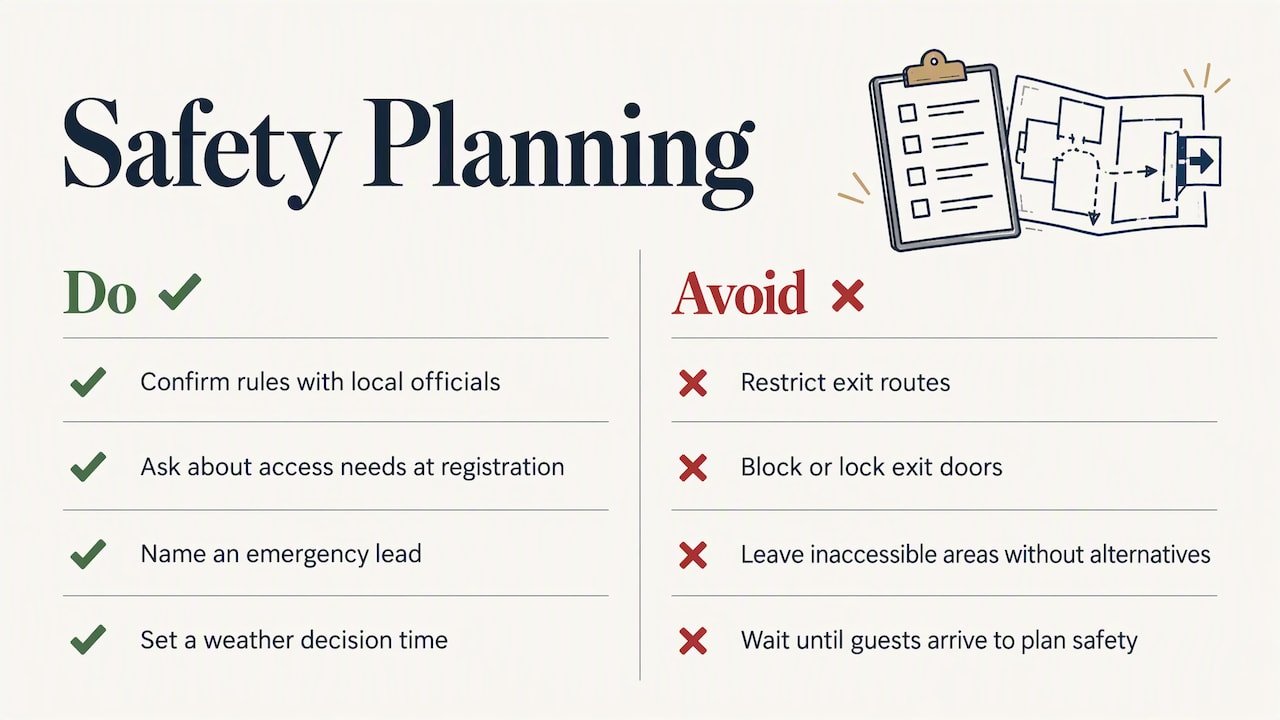
This is the part of a checklist that people skip, and it is the part you most want in place before guests arrive. Your venue, your insurance carrier and your local fire and building officials set the rules for your specific event, so confirm requirements with them.
Accessibility. Under the Americans with Disabilities Act, event guidance from Boulder County states that temporary venues and structures need to be accessible, with an accessible alternative if an area is not. The District of Columbia’s accessible meetings guide suggests asking about accommodation needs at registration and evacuation-assistance needs when attendees confirm, then arranging accommodations and notifying the facility manager. In practice, that means leaving wide, clear paths between tables, checking that any step-and-repeat or photo area can be reached without stairs, and keeping a few seats near the entrance.
Exits and crowd flow. OSHA advises not restricting egress or blocking or locking exit doors. Philadelphia’s special events guide says crowd management plans should include entry and exit strategies, queuing areas and trained security personnel to prevent overcrowding. When you place a bar, a registration table or a photo booth, check that none of them narrows a route to an exit.
Emergency plan. CISA recommends a vulnerability assessment of temporary facilities and coordinating emergency action plans with local law enforcement and first responders, and where possible exercising them with venue personnel and responders. For most corporate events, a scaled-down version means naming a person in charge, knowing where the exits and first aid supplies are, and briefing your team and vendors on who calls whom.
Weather and backup. Write down your rain, heat and cold plan, and the time by which you will decide to use it. Ask rental providers what their requirements are for wind and ground conditions on any tent or inflatable.
7. The final week and 48 hours
The last stretch is about confirmation. A venue’s planning checklist puts it this way: in the final week, lock the guest guarantee and run of show, reconfirm vendors and prepare the event kit. Forty-eight hours before, test presentations and AV and brief the team.
For events with food and beverage, MPI notes that guarantee numbers typically must reach the venue at least 72 hours in advance, so check your contract for its own deadline and do not wait for the last RSVP.
Your final-week list:
- Final headcount sent to caterer and venue.
- Run of show shared with every vendor and team member, with times and phone numbers.
- Delivery, setup and pickup windows reconfirmed with each rental provider.
- Parking and loading instructions sent to vendors.
- Event kit packed: name tags, printed schedule, signage, tape, markers, extension cords, first aid supplies, phone chargers and a copy of every contract.
- Presentations and AV tested on the actual equipment.
- Weather decision made, with the backup plan communicated.
8. Event day
Arrive earlier than anyone else, then walk the space with your venue contact. The same Miami venue checklist suggests checking layout, registration, signage, food and beverage, restrooms, lighting and AV, then doing a soundcheck and briefing staff and vendors. Add three small items from experience with tight load-ins: confirm where each vendor will park, where trash goes, and who signs for deliveries.
A useful event-day order:
- Walk the venue and compare it to your layout.
- Meet vendors on arrival and point each to the right spot.
- Test AV, microphone and any entertainment equipment.
- Set registration and signage.
- Brief the team on timing, accessibility, exits and who makes decisions.
- Greet guests, and keep one person free from tasks to handle problems.
- Track teardown times so rentals are ready for pickup in their window.
9. Closeout: feedback, money and lessons
Planning continues after the last guest leaves. West Virginia University’s educators describe closeout as the step where you reflect on performance, gather feedback and compare planned with actual spending. The University of Florida’s special events guide likewise ends with wrapping up and evaluating performance and recording improvements for the future.
A closeout list:
- Thank people. G2’s event planning guide lists thanking speakers and sponsors, paying outstanding invoices, surveying attendees and reconciling accounting.
- Survey within a day or two. Keep it to a few questions tied to your goal, plus one open comment box.
- Measure against the goal. VistaPrint’s guide says to compare event revenue with total costs for financial ROI, and to measure against the goals you set at the start when there is no direct revenue.
- Plan follow-up. Navan suggests deciding follow-up before the event ends: share content and takeaways, contact prospects and customers, collect feedback, report outcomes and agree next steps.
- Hold a debrief. Share what worked with the full team, then store the run of show, vendor notes and final budget in one folder. MPI notes that post-event statistical reports serve as historical data for future planning, documenting satisfaction and how well objectives were met.
Request a quote for your corporate event
If your checklist includes seating, tents, a photo booth or branded decor, we can help you put the rental pieces together. Party Perfect America is based in North Brunswick, NJ, and serves events in New Jersey, New York and Connecticut. Delivery depends on availability and a location-specific quote, so we confirm it for each booking.

Tell us your event date, location, guest count and what you want to rent, and we will build a tailored package around it. Explore corporate photo booth rentals or start from our rental catalog and request a quote. Availability, setup details, inclusions and pricing are confirmed per booking.
FAQ
What should a corporate event checklist include?
It should cover goals and a success measure, budget, venue, vendors, guest communications, safety and access plans, final-week confirmations, an event-day walkthrough and a post-event review. Most planners start 8 to 12 weeks or more ahead for larger events. Smaller internal gatherings can use a shorter version of the same list.
What are the 5 C’s of an event?
The five C’s are Concept, Coordination, Control, Culmination and Closeout. They run from setting the purpose and goals, through logistics and troubleshooting, to live delivery and post-event evaluation. They work well as headings for your own checklist.
How far ahead should I book rentals for a corporate event?
Book as soon as your date and venue are set, since popular dates can fill up and we cannot guarantee availability for any date. Send your date, location and guest count in a quote request and confirm delivery, setup and pickup windows in writing.
How much of the budget should I hold back?
VistaPrint’s corporate event guide suggests a contingency of 10% to 15%. Use it for headcount changes, weather plans and last-minute equipment needs, and release it only after the event is over.
Sources
- The 5 C’s of event management (Canapii)
- The Five C’s of Hospitality (West Virginia University)
- Successful Event Planning (Utah State University)
- Corporate Event Planning Checklist
- Corporate Event Planning (VistaPrint US)
- Practical Meeting Planning Guide (MPI)
- Corporate Event Planning Checklist (Workshop)
- Special Event Permit Guide (Boulder County)
- District Government Guide on Accessible Meetings
- Crowd Management Safety Guidelines for Retailers (OSHA)
- Special Events Guide (City of Philadelphia)
- Physical Security Considerations for Temporary Facilities (CISA)
- The Ultimate Event Planning Guide (G2)
- Event success checklist (Navan)
- Event Planners: 4 Practical Checks for Inflatable Product Replicas